Do you happen to know a group of people that always end up in the exact same conflict? The confrontations play out mostly unchanged, again and again, making everybody involved unhappy but still never getting properly resolved?
That group (maybe you’re even part of it?) might be forming a Karpman Drama Triangle. It’s a model of social interaction for long-term conflict – situations that exist for weeks or months, sometimes years. I’ve certainly come across some Drama Triangles, mostly at work, rarely in my private life (phew).
What really surprised me in the model was the role of the Rescuer. The other two roles, Persecutor and Victim are easy to spot in a conflict, but the Rescuer is more subtle and the role I personally am most at risk to slip into. Karpman’s model really helped me see that.
But let’s get to it, here’s the three faces of drama, the Karpman Drama Triangle:
Help us spread knowledge and become a Wall-Skills supporter <3
Content of 1-Pager:
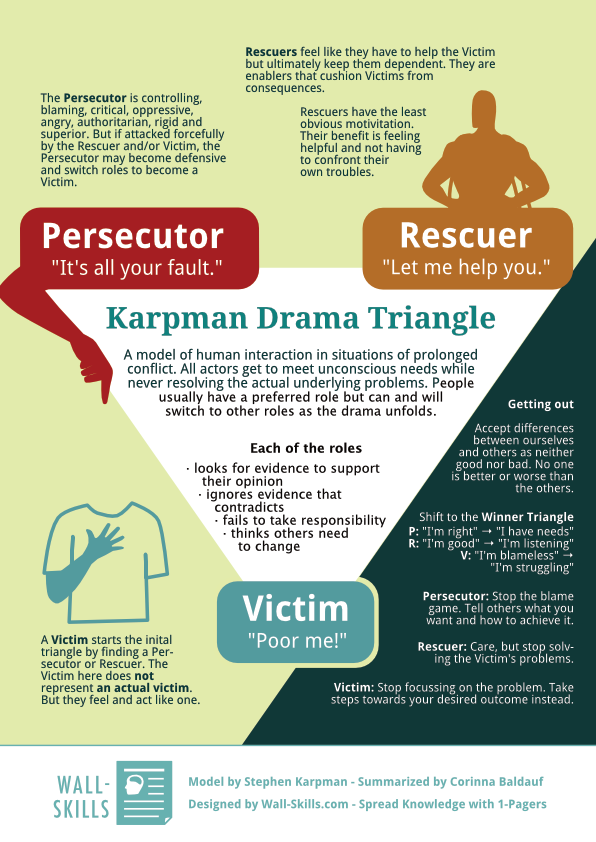
Karpman Drama Triangle
A model of human interaction in situations of prolonged
conflict. All actors get to meet unconscious needs while
never resolving the actual underlying problems. While
people have a preferred role, they can and will
switch to other roles as the drama unfolds.
Each of the roles
- looks for evidence to support their opinion
- ignores evidence that contradicts
- fails to take responsibility
- thinks others need to change
Persecutor – “It’s all your fault!”
The Persecutor is controlling, blaming, critical, oppressive, angry, authoritarian, rigid and superior. But if attacked forcefully by the Rescuer and/or Victim, the Persecutor may become defensive and switch roles to become a Victim.
Rescuer – “Let me help you.”
Rescuers feel like they have to help the Victim
but ultimately keep them dependent. They are
enablers that cushion Victims from
consequences.
Rescuers have the least obvious motivitation. Their benefit is feeling helpful and not having to confront their own troubles.
Victim – “Poor me.”
A Victim starts the inital triangle by finding a persecutor or rescuer. The Victim here does not represent an actual victim. But they feel and act like one.
Getting out
Accept differences between ourselves and others as neither good nor bad. No one is better or worse than the others.
Shift to the Winner Triangle
P: “I’m right” → “I have needs”
R: “I’m good” → “I’m listening”
V: “I’m blameless” → “I’m struggling”
Persecutor: Stop the blame game. Tell others what you want and how to achieve it.
Rescuer: Care, but stop solving the Victim’s problems.
Victim: Stop focussing on the problem. Take steps towards your desired outcome instead.
Sources:
I think I first learned of the concept from Caitlin Walker. In “From Contempt to Curiousity” maybe? It’s definitely featured prominently in “So you want to be… DramaFree” which she wrote together with Marian Way.
- Wikipedia – I likely have copied some text verbatim for the 1-pager
- https://bpdfamily.com/content/karpman-drama-triangle – Entire passages are the same as on Wikipedia but they also added a lot on how to break out of a triangle. The advice on how to get out of a drama triangle is by
- Margalis Fjelstad
- and Acey Choy – Winner Triangle
- David Emerald – The Power of TED